7 Most Beautiful Gardens in Portland Oregon
I’ve been visiting Portland my whole life because I have family there. Over the course of Thanksgivings, spring break trips, and visits for work, I’ve gotten very acquainted with the City of Roses. And my ultimate favorite thing to do in Portland is to explore their many MANY gardens. Not only do they have some of the most beautiful gardens in Portland, Oregon, but they have some of the most beautiful gardens in the world!
I’ll share my top favorites with all the info you need to make the most of your visit including admissions, parking logistics, when to visit, and what you can see while you’re there.
P.S. This list is only gardens, not parks as there are tons of parks in Portland with garden-like elements — aka flowers, trees, curated plants, etc.

Map of the Top Gardens in Portland, Oregon
7 Best Gardens In Portland, OR
1. Portland Japanese Garden
The Portland Japanese Garden was famously visited by the ambassador of Japan in 1988 and he claimed it was the “most beautiful and authentic in the world outside of Japan.” So, it’s no wonder that the Portland Japanese Garden is one of the top activities in Portland for visitors.
You’ll find the Japanese Garden in Washington Park, one of the city’s oldest public parks that opened in the late 1800s. The Japanese Garden was designed in 1963 and spans 12 acres with 8 garden styles within Washington Park.
While Washington Park is free to visit, Portland Japanese Garden has its own admission and (tiny) parking lot, where parking is $2 per hour throughout all of Washington Park including the Japanese Garden lot.

Pro tip: You can use the app Parking Kitty to pay for parking around the city and in Washington Park, you can move your car between locations keeping the same payment allotment going.
Alternatively, you can park anywhere in Washington Park if the Portland Japanese Garden lot fills up and take the free Washington Park shuttle to the garden.
The Portland Japanese Garden is known for its tranquility, delicately manicured gardens, and views of Mount Hood.
When you first arrive, you’ll be greeted with a massive entry way and trail that leads you up through Japanese gates away from the city and into a serene escape. This is actually the first garden and was part of an expansion in 2017 to create a more cohesive entry to the gardens.

This was accomplished by creating the Cultural Village, which now welcomes guests with new buildings including Umami Cafe, the gift shop, a concierge, and the Jordan Schnitzer Japanese Arts Learning Center, where you’ll find art galleries, a library, and exhibits dedicated to helping visitors learn more about the Japanese culture that inspired the gardens.
Don’t miss the Zagunis Castle Wall, which is hiding toward the back of the Learning Center. This is an incredibly massive and impressive feat that deserves to be seen, even if it’s hiding a bit!
This is a medieval-style castle wall that measures 18.5 by 18.5 feet and was built by Suminori Awata, a 15th-generation stonemason (!!) using traditional methods including hand tools. It’s the first of its kind outside of Japan!
It’s story is just as interesting because it was built for its function as well as its call to traditional Japanese culture. Kengo Kuma, the architect who spearheaded the Cultural Village expansion, and Sadafumi “Sada” Uchiyama, the garden curator, decided to implement a traditional castle wall as the necessary retaining wall to hold back the western slope.

Finally before heading into the main gardens, there’s also a bonsai terrace at the Cultural Village that is incredibly beautiful and serene.
I recommend going counterclockwise around the historic gardens once you pass through the Nezu Gate.
This will first take you to the Flat Garden and Pavilion Gallery. The Flat Garden represents the balance of space with natural items that create a depth of field, despite the flat landscape. It’s meant to be viewed from the Pavilion Gallery veranda or from within behind its sliding doors.

Be sure to head around back for the Mount Hood overlook. Fingers crossed for a clear day!
Continue counterclockwise to the Sand and Stone Garden, which celebrates the beauty of blank space. The Natural Garden is next and was curated to encourage visitors to pause and reflect on the essence of life. (Super casual).
Address: Directly above the International Rose Test Garden at 611 SW Kingston Avenue, Portland, Oregon 97205
Hours: 10 am – 6 pm daily, closed Tuesdays
Admission: $21.95 for adults, $17.95 for students
Best time to visit: year round, most vibrant colors in late May and autumn
Accessible: partially (some parts are not fully ADA accessible)
2. International Rose Test Garden
Just across from the Portland Japanese Garden is the International Rose Test Garden, which is an experimental garden that literally tests new varieties of roses. Be still my science heart.
The Rose Test Garden was developed in 1917 thanks to the Rose Society President. Now, it’s home to over 10,000 rose bushes and new varieties are planted each year for testing. And you might be thinking, what does that even mean “testing roses”? Well, in order to determine if a specific variety of rose can grow in gardens around the world, they are formally evaluated on how they perform in this garden in Portland!

When you visit, you’ll see those being tested in Sections B and C, where the rest of the garden is home to historically significant roses or those that you can find commercially already.
Visiting the Rose Test Garden is a timing game, because roses aren’t in bloom year round. In fact, in winter the bushes are pruned to protect them from seasonal wind and rain. For the best viewing, you’ll want to visit in late-May through October.
There’s a kiosk on the upper level that has a key with all the varieties of roses that you can find and where exactly to find them. It’s like a flowery treasure hunt!

Alternatively, they offer a guided tour at 1pm each day from Memorial Day to Labor Day that meets at the Rose Garden Store on the western end of the garden.
As you walk through the garden, be sure to see the Dog Rose, a 1,000 year old rose, the gazebo and Shakespeare garden, which features plants and roses mentioned in Shakespeare works or were named after characters found in such, and the Gold Medal Garden, which has all of the winners of the Gold Medal Award honoring roses for their performances in the Pacific Northwest.
To get there, there is extremely limited parking, which can be paid for via the Parking Kitty app at $2 per hour.
Similarly to the Japanese Garden, it can be easier to get there via the free Washington Park shuttle. You can even take public transport where bus line 63 stops in at the garden and MAX Blue and Red lines (Portland’s light rail) stop at Washington Park. From the Washington Park stop, you can hop on the free shuttle to get even closer to the Rose Test Garden and Japanese Garden.

Address: 400 SW Kingston Avenue, Portland, OR 97210
Hours: 5 am – 10 pm daily
Admission: free
Best time to visit: late May through October
Accessible: partially (the main promenade was paved in 2017)
3. Lan Su Chinese Garden
I LOVE the Lan Su Chinese Garden. While the Portland Japanese Garden can get super crowded, I found that the Lan Su Chinese Garden maintained it’s tranquility and wasn’t overly crowded.
The Lan Su Chinese Garden opened in 2000 and is located in historic Old Chinatown in downtown Portland. It was built by Chinese artisans from Portland’s sister city, Suzhou, in China and is considered one of the most authentic Chinese gardens outside of China.

Their goal is to support the celebration and understanding of people of all backgrounds. And on that note, it’s one of the only fully accessible gardens in Portland!
You’ll notice that Lan Su Chinese Garden melds nature, art, history, and architecture to create a dynamic experience for visitors.
It’s a really wonderful, peaceful place to visit because you can see everything by taking a simple loop around the garden. No getting lost and needing to consult a map every 2 seconds.

The garden is modeled after a wealthy 16th-century family home in China, so some buildings and features are included to demonstrate the roles that they would have played.
You begin in the Courtyard of Tranquility and it’s such a welcome juxtaposition between the downtown just outside the gates and the aura of peace within.
Don’t miss the Scholar’s Courtyard, which features a stone mosaic that symbolizes the coming of spring and therefore, endurance and hope. The Scholar’s Study is an extension of the courtyard and is where men of the family would study for exams and ensure their prosperity.

The teahouse is located inside the Tower of Cosmic Reflections, where women of the family would admire the garden and manage the family’s finances. The teahouse has been newly reopened and continues to promote the cultural art of tea where you can slow down, enjoy a cup, and grab a snack.

Metered street parking is available around the garden at $2 per hour, where it’s free on Sundays before 1pm. And while, I won’t make any blanket statements about safety in Portland because the feeling of safety is incredibly relative, petty theft has become a problem in recent years, especially downtown, so if you are parking on the street, be sure to conceal any belongings, take valuables with you, and lock your car door.
You can also get there via public transportation, where the closest stop is Old Town Chinatown on the Blue and Red MAX lines (Portland’s light rail). The same stop is closest on bus lines 1, 4, 5, 8, 10, 16, 33, 40, and 77. You can plan your public transport route via TriMet here.

Address: 239 Northwest Everett Street, Portland, Oregon 97209
Hours: 10 am – 4 pm daily
Admission: $14 for adults, $13 for students
Best time to visit: year round
Accessible: yes! (this map shows the accessible route)
4. Crystal Springs Rhododendron Garden
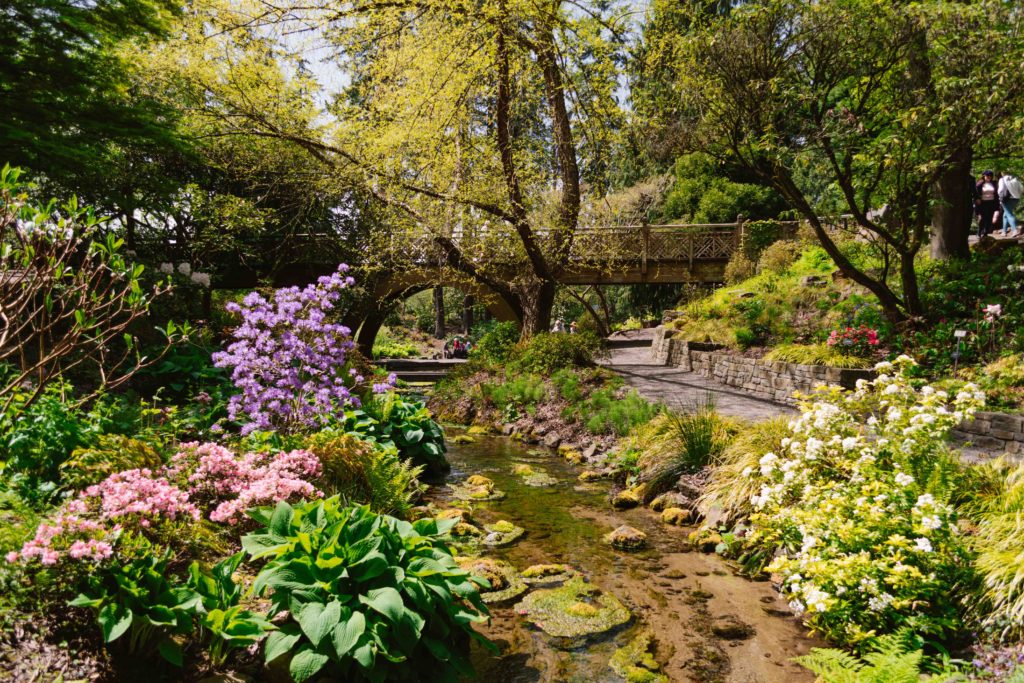
This was by far my favorite garden in Portland — great value, massive size, and truly beautiful trees, flowers, and plants. And baby ducks! Plus, three waterfalls, two bridges, one fountain, and a lake.
Crystal Springs Rhododendron Garden was established in 1950, spans 9.5 acres within the city, and provides a tranquil escape surrounded by beautiful greenspace.
I particularly loved birdwatching in this garden. While I’m certainly a novice, we spotted a bald eagle! Plus, they note that 90 species of bird have been seen in the garden, so you never know what you’ll find!
We loved the geese, especially this mama who was sitting on her nest.

Logistically, the most important thing to know is that the parking lot is quite limited. While you can drive and park, if there are no spaces, there’s not really anywhere else nearby to park.
Because parking is so limited, they recommend getting there via a ride share, biking, or public transportation. For public transit, navigate to TriMet bus 19, which is accessible from the Orange light rail, to the SE 28th & Martins stop, which is closest to Crystal Springs Rhododendron Garden.

Address: 5801 SE 28th Avenue in Portland, Oregon
Hours: 10 am – 4 pm daily, 1pm opening on Wednesdays, last entry at 3:30 pm
Admission: $5, free on Mondays
Best time to visit: April through June
Accessible: yes! (for detailed info, visit Disabled Hikers here)
5. Hoyt Arboretum
While some of the other gardens on this list were my favorites, Hoyt Arboretum was downright impressive and left me wishing more cities put an effort to curate greenspaces like this. Hoyt Arboretum is a literal living museum of trees.
It was founded in 1928 with the goal of conserving endangered species of trees. Now, it covers 190 acres with 12 miles of trails and 2,300 species of trees from 6 continents.
Not only that, but the arboretum is FREE!

One of my favorite parts of the arboretum is that the trails are incredibly easy to understand because they’re named after the primary tree you’ll see on that trail. Walking on the Magnolia Trail will lead you through the Magnolia Collection. I’ll give you a guess what’s on the Redwood Trail.
Now, the redwoods deserve a special mention because did you know that redwood trees only grow naturally in 3 areas of the world? Northern California, China, and yepp, Portland, Oregon!
If you do nothing else, be sure to walk the Redwood Trail up to the redwood deck. You can get there from the Visitor Center by going across the street and taking the Fir Trail to the left or Spruce Trail to the right, both of which connect to the Redwood Trail.

Depending on when you visit, certain trails will be in bloom. I recommend a stop in the Visitor Center to ask them where they recommend!
There’s parking at the Visitor Center, on SW Fischer Lane, on SW Fairview Blvd., on SW Cascade Drive, and at the corner of SW Kingston Drive and SW Knights Blvd. Parking costs $2 per hour, like the rest of Washington Park.

You can also get to the Visitor Center via the free Washington Park shuttle or via bus line 63. Similarly to the other gardens in Washington Park, you can take the red and blue light rail lines to access the free Washington Park shuttle to navigate the park and get to Hoyt Arboretum.
And, just for fun, you can take the eastern side of the Wildwood Trail to the Portland Japanese Garden and International Rose Test Garden.

Address: 4000 SW Fairview Blvd., Portland, OR 97221
Hours: 5 am – 10 pm daily
Admission: free
Best time to visit: year round (certain blooms are time of year specific — like magnolias in late spring)
Accessible: partially (Visitor Center, Overlook Trail, Vietnam Veterans Memorial, and Bristlecone Pine Trail)
6. Leach Botanical Garden
With the goal of being an immersive, restorative, and educational beacon of nature, Leach Botanical Garden sits in Southeast Portland along a free-flowing creek.
Known for their aerial tree walk, they also have native plants, a pollinator garden, and basalt stone sculpture installation.
Leach Botanical Garden covers over 17 acres and has an historic home, called Sleepy Hollow estate, once owned by the Leach family and who had an affinity for botany.
They have a ton of really interesting events to discover and learn about the garden and home. For example, you can take a workshop on rigid heddle weaving, tour the garden with an emphasis on plant history, and go for a forest bathing walk, inspired by Japanese art of Shinrin-Yoku. Note that the events range in price from $10 to $130. For example, a 3 hour botanical bundle dyeing workshop is $130 and accounts for the workshop instruction, materials, and finished product. Whereas, a simple guided walking tour of the garden is only $10.
You’ll find two parking lots and a compact cars lot and they welcome visitors to drop off guests at the upper lot then park where available. You can also get there via public transit on bus lines 10 and 73 where the closest stop is 122nd and Foster.

Address: 6704 SE 122nd Ave., Portland, OR 97236
Hours: 10 am – 5 pm weekdays, 10 am – 4 pm weekends, closed Mondays
Admission: $5
Best time to visit: year round (particularly beautiful spring and fall)
Accessible: partially (these pathways are ADA accessible)
7. Peninsula Park Rose Garden
Located in the Piedmont neighborhood of Portland, sits this unsuspecting rose garden. Peninsula Park Rose Garden has been around since 1913 (even before the International Rose Test Garden) and was the site of the original cultivation of Portland’s official rose Madame Caroline Testout (pronounced Test-oh).
Many roses were moved to the International Rose Test Garden upon its initial establishment from Peninsula Park Rose Garden, but there are so many beautiful elements that remain in the park including roses.

Don’t miss the historic octagonal bandstand that was used in World War I for patriotic demonstrations and performances. In fact, it’s the only remaining one of its kind in Portland and is designated a National Heritage historic structure.
Check out this map, which shows all species of roses planted in the 32 beds that cover the garden!
Street parking is available surrounding the garden and park. To get there via public transportation take bus 44 to N Rosa Parks Way & Albina, bus 4 to N Albina & Ainsworth, or bus 72 to N Killingsworth & Albina.
Address: N Albina Street and Ainsworth Street, Portland, OR 97217
Hours: 5 am – midnight daily
Admission: free
Best time to visit: mid-late June through October
Accessible: partially (brick pathways that create a T around the center fountain)
I hope you’re able to visit some of the many beautiful gardens in Portland, Oregon on your trip and enjoy a little serenity in the city.
More Pacific Northwest resources:
- Portland weekend itinerary
- Best food tours in Portland to take
- Things to do on the Columbia River Gorge
- Weekend in Seattle itinerary
- How to spend a day in Seattle
- Your guide to the Skagit Valley Tulip Festival in Washington
- Best things to do on the West Coast (including Oregon and Washington)
- Road trip itinerary for Washington National Parks

My Travel Essentials
- Travel Insurance – Going on an international trip? Don’t forget travel and medical insurance with SafetyWing.
- Travel Card – If you’re new to travel hacking, fear not! My favorite card for beginners gives you $750 in rewards when you spend $4,000 in the first 3 months, plus lounge access, 10x points on hotel bookings, and free TSA pre-check!
- Get Your Guide – Check out Get Your Guide for a one-stop-shop for booking travel activities.
- Booking.com – This is my favorite hotel search aggregator, specifically for reading reviews. On Booking.com, the reviews can be searched for keywords like WiFi, breakfast, pool, amenities, etc.! So helpful!
- Anti-pickpocket bag – Worried about having your valuables swiped? PacSafe makes the best travel bags with zippers and straps that lock and with mesh steel enforced fabric.
- Give the Gift of Travel – This is the perfect gift for travelers in your life! Tinggly allows you to gift experiences around the world, perfect for birthdays, weddings, or anniversaries.
- Staycation Idea – Check out Resort Pass, which gives you day passes to resorts so you can use their pool, spa, and fitness center, a great staycation idea!
Save to Pinterest