Everything You Need to Know Before Swimming with Manta Rays
So you’re ready to check off this incredible experience from your bucket list? Well, swimming with manta rays is certainly a once-in-a-lifetime opportunity and worth every penny. Still, there are lots of ins and outs to know about ahead of time so you can be best prepared and ready for the absolute best time!
And just to hype myself up and prove to you that I’m not just some schmuck behind the screen, I got certified to scuba dive when I was 12 😱 and I’ve snorkeled all over the world, in Bora Bora, the Bahamas, The Maldives, Hawaii, and probably more that I’m forgetting (I’ve been traveling since I was a kid!).
Plus, I’m a scientist! I have my PhD in Chemistry and while that’s certainly a far cry from marine biology, I can research well (my 100+ page dissertation says so) and I will forever prioritize our earth, environment, and the beautiful creatures that call it home! So in this guide to swimming with manta rays, I’ll share my experience (I snorkeled), what to expect, and useful information when it comes to these creatures and having an eco-conscious experience with them.

How can you swim with manta rays?
Boat viewing
Okay this one isn’t technically swimming, but I love that this is an option for those who are uncomfortable in the water or can’t swim.
Sometimes, there are boat tours that will take you out into the water to observe the manta rays from the comfort of the boat. Of course, it can be trickier to see them from above the water and running a boat to follow them around isn’t a great way to ensure they stick around.
However, if you can’t swim, this is certainly a good option to consider!

Snorkeling with manta rays
When I say swimming with mantas, you’re probably picturing snorkeling or scuba diving. More on the latter in a moment.
Snorkeling with manta rays is the most common option to get up close with these gorgeous creatures as it’s the most accessible.
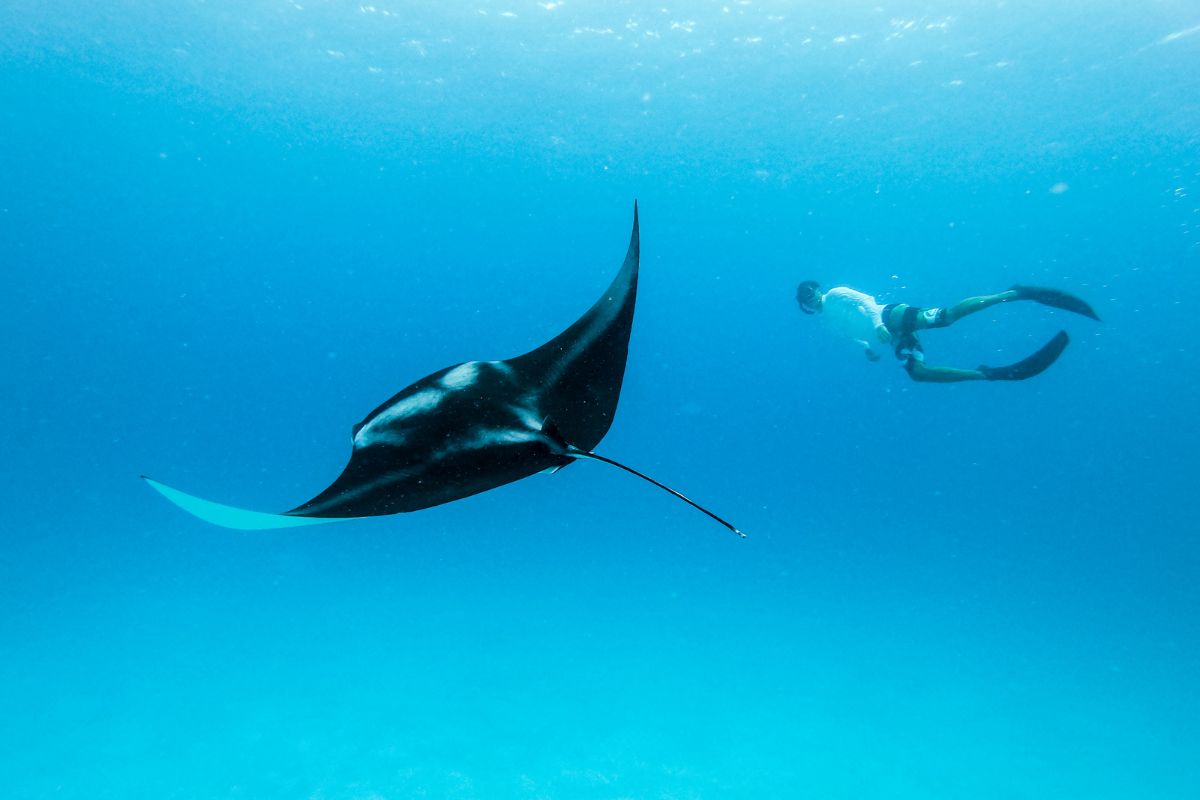
When you snorkel with the rays, you can get into the water, float on the surface, and gently swim to follow them should you need to.
Snorkeling is one of the best ways to see manta rays close up with no training needed!
Manta ray diving
Scuba diving is the final way to swim with manta rays and requires a bit more time and effort as you need to get certified. Scuba divers incur some risk as you’ll be descending meters below the surface and breathing from an oxygen tank.
Learning techniques to handle pressure underwater, as well as learning to use the equipment properly, requires training. You can do so by taking an Open Water Diver Course through PADI (Professional Association of Diving Instructors). They have an online course portion and in person training in a pool then a monitored open water dive to test your skills.
You can find these courses in your local town (even small towns like my own, Knoxville, have them, so don’t quit before you look). Alternatively, if you’re staying at a resort or visiting a tropical destination, you can find courses there.

Night manta ray swim
One option that I totally wish I did is a night swim with manta rays. The way this works is that typically, you’ll use light to attract plankton, which the manta rays eat.
I’ve seen tours where you hold onto a floatation device that shines the light below, so you don’t need to swim and move around. You just hang onto the light and wait for the mantas to show up to eat!
Manta ray behavior to observe
As part of my manta ray excursion, I attended a talk by a biologist before boarding the boat and heading out. I’ll share what she said so you know what to expect, too!
First, you may catch them eating. That’s the easiest way to spot them and most reliable, especially at night when you can attract plankton with light. They eat tiny plankton and when they do, they swim in giant circles. Their cephalic fins, which kind of look like horns, help guide the plankton into their mouths as they swim around.
Second, you may spot them being cleaned at the bottom of the ocean floor or reef by wrasse fish. When that happens, the manta rays line up in a queue waiting for their turn to be cleaned. How cute!
Finally, it’s possible to see them simply swimming around. This one is a game of luck and isn’t the most reliable. Chances are it’ll be one of the former two behaviors.

Where can you swim with manta rays?
The two most popular destinations for diving and snorkeling with manta rays are Hawaii, specifically Kona, where night swimming is popular and The Maldives, which is home to the largest feeding area of manta rays in the world!
You can also snorkel with manta rays in Indonesia including Nusa Penida, Socorro Island in Mexico (home of the giant oceanic manta ray), and the Galapagos.
When is the best time of year to swim with mantas?
This is heavily location dependent, so it’s best to consult your tour guide company or resort.
For example, in Kona, it’s May through September (summer) and in The Maldives it’s September through May, where the winter is the best! I went to The Maldives in December and we spent a good 30+ minutes watching a manta ray feed on plankton. A dream come true!

How close can you get to the manta rays when swimming?
Typically, you’ll be 10 feet or more from the manta rays. When snorkeling, you’re floating on the surface and they’re swimming below you.
When scuba diving, you’ll be swimming near them but maintaining a respectful distance. This isn’t because they are dangerous, but rather to prevent causing them stress.
It’s possible that the manta rays will approach you when swimming out of curiosity and it’s best to remain still and calm.
On my snorkel trip, they came within 5 feet of us swimming directly under us as we floated on the surface. Because of that, it’s best to remain horizontal on the top of the water rather than vertical with your head up and feet/fins down in the water.

Can you touch the manta rays?
Even if they get super close to you, no, do not touch the manta rays. It’s discouraged as it can disrupt their natural behavior, remove their protective mucus layer on their cartilage, or even cause injury (your nails are especially dangerous to manta rays).
It’s best to keep your hands, feet, and fins to yourself.
If you want to pet some rays, it’s best done at an aquarium!

What type of manta rays can you see?
Yepp, there are multiple species of ray including manta rays. Most reef manta rays are around 11 feet in diameter, but you may even spot a giant oceanic manta ray, which is the largest in the species and can be 29 feet wide!
Do manta rays sting?
No! While they have a long tail, they actually don’t have a poisonous tail stinger! They can’t sting you.
That said, please be respectful of these creatures. You’re there to observe with your eyeballs only!

Can everyone do this?
Yes and no. Individual tour operators may have age requirements, likely for liability reasons.
As far as swimming ability goes, everyone can at least do a boat tour, if available! Often times, you don’t even need to be a great swimmer if you’re snorkeling as most tour providers will give you a lifejacket anyway. It’s always best to consult them first, though.
And again, scuba diving likely requires certification. There are introductory dives where you do a briefing before getting into the water, but those are typically shorter, more shallow dives anyway. If you want the real deal, get certified first.

Is swimming with manta rays ethical and eco-friendly?
If done right, yes. It’s up to the certified tour operators to adhere to guidelines when it comes to sustainable tourism.
It does fall on you to choose your tour operator wisely to ensure that you are participating in an eco-friendly excursion. When in doubt, ask the company how they prioritize the well-being of the marine environment and how they follow best practices for wildlife encounters.

Best manta ray Hawaii tours
On the Big Island in Kona, their specialty are night tours! Here are some great options.
Top Maldives manta ray excursions
The Maldives can be a little more tricky because there are literally over a thousand islands and each resort has their own private island. Still it’s one of the best things to do in The Maldives, so it’s worth figuring out!
If you’re staying at a resort like the Conrad Maldives, check in with their dive center for excursion options.
You can find some local tours on islands like Maafushi and in the capital itself, Malé.
How long can you swim with manta rays?
Typical sessions and excursions last 30 minutes to an hour to minimize the disruption to the animals. Not to mention, it can be tiring to swim for longer.
How much does it cost?
I’ve seen tours from $90 and up in Hawaii with more expensive tours in The Maldives at private resorts. This is likely because on private islands you only have one option as you can’t just jump from island to island in the Maldives. You have to take a seaplane or boat to transfer between islands. That said, we paid $250 per person in The Maldives at our hotel, the Conrad.
It was worth every penny!

What to bring when swimming with manta rays
Because you’ll be closer to the equator for your manta ray experience, it’s important to come prepared for intense sunlight.
I recommend UV blocking swim clothes, specifically a long-sleeved shirt and pants. I wore a regular bathing suit and the amount of sunscreen I needed to feel amply protected was ridiculous. Covering myself with UV swim gear would have been so much easier!
And note that on local islands in The Maldives, bikini bathing suits are not permitted, you’ll need a one piece.
Still, you’ll need sunscreen. Make sure you’re using reef-safe sunscreen without nanoparticles. I like this one.
- Bathing suit
- UV-protection long-sleeve top
- UV-protection swim pants
- Reef safe sunscreen
- Water bottle
- GoPro
- Towel, if not provided (I like these packable microfiber ones)
- Sunglasses
- Sea sickness prep (medication or Sea Bands)
- Snack
Tips for swimming with manta rays
1. Be prepared for intense sun
I know I just said this, but in case you skipped to the tips, the UV rays are intense this close to the equator. If you don’t burn at home, expect to get fried here. Come prepared with UV-protection (clothes and sunscreen).

2. You might get stung
No, not from the manta rays. They can’t sting you as they don’t have poisonous stingers. However, if you find mantas when they are eating plankton, the plankton (little bastards) can and will absolutely sting you…all over any exposed skin on your body.
Yeah, I wasn’t thrilled about that either. It feels like tiny electric shocks and isn’t super painful. But it’s also not the greatest feeling in the world.
Our guide had a homeopathic remedy on the boat if your stings lasted longer than 10 minutes or if they were bothering you immensely.
Honestly, I recommend doing your best not to worry about it and when in doubt, wear the UV-protected swim gear, specifically long sleeves and long pants!
3. Manage your expectations
As with any wildlife viewing, it’s always a possibility that you won’t see what you’re looking for. Take any “guarantee” with a grain of salt and know that it’s impossible to guarantee seeing what you’re looking for unless the ethics are in question.
Check out these other resources:
- How much it costs to go to The Maldives
- Guide to seaplane travel in The Maldives
- Best things to do on the US West Coast (manta swimming is on this list)
- Places to visit in summer in the USA (Hawaii is on this list)
- Conrad Maldives hotel review including their manta excursion
- Ultimate travel bucket list
- How to find the best things to do on vacation

Save to Pinterest